Elburuz Fidan
Department of Parrots
From Archival Form/less to an Atlas of Queer Plasticity
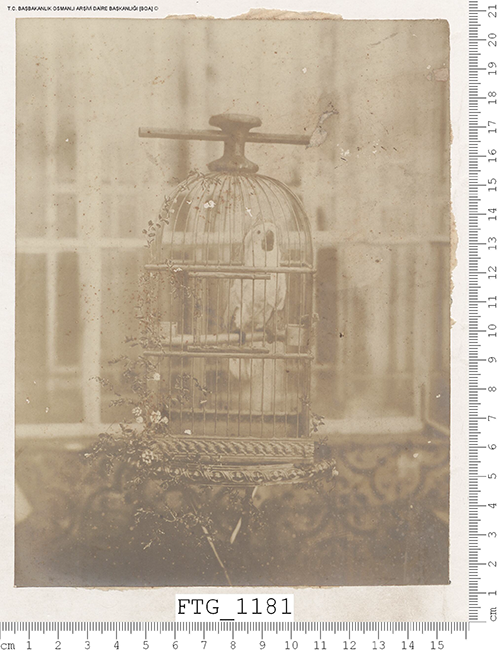
FTG_1181 “A parrot in a cage”. Turkish State Archives Depository, Ottoman Archives.
This text introduces an ongoing artistic research project that conducts a comparative study between the Ottoman Archives Photography Section and the archive of the Schwules Museum through a Queer lens. As part of an evolving research trajectory, this project juxtaposes a normative state archive with a non-normative counter-archive. It gathers "discarded" archival materials, highlighting their Queer aspects, into a catalog structured as an Atlas. Engaging with Gayatri Gopinath’s concept of "Queer Optics" (Gopinath 2018), Sara Ahmed’s theory of "Queer Use" (Ahmed 2019), and Catherine Malabou’s philosophy of "Plasticity" (Malabou 2012), the research aims to uncover and interpret archival materialities through a queer diasporic perspective. This approach seeks to make visible previously unseen or overlooked materials, which, due to their limited information, might not traditionally qualify as scientifically usable evidence. Following Sara Ahmed's specific definition of "Queer Use" (Ahmed 2019), the "discarded" condition of these archival materials becomes a central category within this research. Based on this category, the archive, as a non-human information container, exhibits similarities to a brain. Indeed, through the archive's particular usage and the activation of its contents, information is transformed into knowledge. The scalability of this knowledge production is not only limited to the archive's own cerebral structure but also circulates within and through human and other non-human cerebral systems as referencable, solid knowledge. This function—to use specific archival material and imbue it with particular meaning through its information—can generate diverse forms of knowledge, depending on the interacting actors within the archive. Likewise, erasures, silences, ordered arrangements, and the anonymous body of the archive and its materials, as a non-human cerebral structure, undergo plastic changes that traumatize living forms and cause formless wounds, where the archive itself cannot remember, recite, recall, return, or relate. In a similar vein, Catherine Malabou’s work on Plasticity discusses the role of irreversible cerebral changes that transform a former "form" into "formless" as a new being (Malabou 2012).
At the intersection of "Queer Optics" (Gopinath 2018), "Queer Use" (Ahmed 2019), and "Plasticity" (Malabou 2012)—conceptualized as a theoretical body of 'doings'—the research's encounter with FTG_1181, "A Parrot in a Cage," an archival material from the Ottoman Archives Photography Section, transforms into a Queer artistic methodology for this research. The Ottoman Archive’s Photography section is characterized by an overwhelming amount of anonymity, silenced histories, erased memories, and literal violence depicting wounds. It contains incorrect captions and offers a polyvalent body of meanings, yet much of it is deemed unusable for historical scientific knowledge production. As a unique member of the archive, FTG_1181 depicts, as its caption states, a parrot in a cage. Amidst photographic artifacts portraying anonymous individuals, furniture, landscapes, wounds, and medical interventions, this parrot stands out as the sole non-human participant in this photography section. Due to its seemingly irrelevant positioning and missing evidential information, as well as its ordered and disordering categorization, the parrot qualifies as a "discarded" archival material that challenges the normative attributes of the collection. By adapting "Queer Use" (Ahmed 2019) to FTG_1181, the research first examines the analogy of the parrot as a captive within the archive. As an archival insider, a witness in captivity, the parrot engages in a Queer kinship with other anonymous, discarded archival materials. To counter the hegemonies of the Ottoman Archive and its contemporary usage within the Nation-State of the Turkish Republic, the research initially employs an installation. Through assembling my own desire to learn from the parrot and discover what kind of information it could deliver, and by restaging the parrot’s absence within the installation, it becomes clear that the parrot's freedom as an archival material is the only way to produce new knowledge. This process transforms the "information" of captivity into a desire for knowing, forming its own cerebral information container with relevant information that the archive has discarded from the captions of its artifacts. This essential dynamic of knowledge production is intrinsically adapted within the installation as an open window. Following the literal attributes of the parrot, in its interaction with humans as a colonized member in a domestic setting, again as a captive, it performs repetitive forms in an ordered manner. The randomness of its auditory articulation resembles its surrounding non-human actors. Limited in concrete articulation, every recitation of its cerebral capacities hints at an inaccuracy in form and time—sometimes in an exaggerated new form of repetition, sometimes shifted from the order its human companion expects. This disordered form of repetition hints at evidence of events that occurred in the domestic area. This makes the parrot a vulnerable truth-bearer, capable of restaging information in a performative way, reenacting an accurate copy of an auditory example almost in the form of an archival record. Such activation, depending on the information, can expose the secrecy of its hegemonically controlling human. Related to these cerebral conditions, deriving from the parrot's own cognitive plasticity (Malabou 2012), the research developed an artistic methodology named "Rererere." This methodology exaggeratively uses the "re-" prefix and words starting with "re-" to order its contents within the Atlas of Queer Plasticity. "Rererere" is a deliberate, repetitive form of exaggerated knowledge reproduction and recirculation that "rereasons," "reconsiders," "reflects," "represents," "relocates," "returns," "respects," "recites," "rewrites," "reminds," "reenacts," and "retreats" the archive with research-relevant insights regarding the polyvalent, Queer, discarded archival information within the Ottoman Archives Photography section and the archive of the Schwules Museum.