Bianca Holtschke
Bianca Holtschke is a graduate designer who studied Integrated Design at the University of the Arts Bremen (HfK Bremen) and at the Royal Academy of Art in The Hague, Netherlands.
She works as a freelance graphic designer, typographer, and book designer, and realizes design projects using CAD, 3D printing as well as UI Design.
Currently, Holtschke is pursuing a practice-based PhD at HfK Bremen, supervised by Prof. Dr. Annette Geiger and Prof. Dr. Anke Coumans (Minerva Groningen). Her research explores how complex content can be made comprehensible through design from a neurodivergent perspective, drawing on pragmatism, semiotics, and logic.
As an autistic person, Holtschke actively advocates for accessibility and inclusion, bridges insights from neurodiversity research with design. Accordingly, together with her partner Timm Bölke, she developed an AI-powered assistant for neurodivergent adults (Neurodiversity AI) —which won the CAMPUSiDEEN Impact Award.
Holtschke teaches at HfK Bremen. Her essay "Können Bilder falsch sein?" was published in "Piktogrammatik: Grafisches Gestalten als Weltwissen und Bilderordnung," co-edited with Annette Geiger (transcript, 2021).
https://bianca-holtschke.de/
RESUME
Selected Awards and Scholarships
Awards
CAMPUSSIDEEN “Impact Award”.
German Photo Book Prize, Silver for the photobook Room 125 (Kerber).
Lucie Photo Book Prize, Finalist for the photobook Room 125 (Kerber).
Hochschulpreis der Hochschule für Künste Bremen for Eins zu Zwei.
Hochschulpreis der Hochschule für Künste Bremen for the magazine Der schöne Mann.
Art Directors Club New York, Gold Award, for the magazine Der schöne Mann.
red dot design award for the supplementary book to the 23rd Forum Typographie.
Scholarships
Promotionsstipendium der Hans-Böckler-Stiftung.
Studienstipendium der Studienstiftung des deutschen Volkes.
Selected Publications
Holtschke, B. (in preparation). “You see, but you do not observe.” — Sherlock Holmes’ Method as Interface Between Visual and Logical Thinking. In A. Geiger, B. Holtschke, & J. C. Ahrend (Eds.), Pictologic – How images give form to our knowledge and imagination. transcript.
Holtschke, B. (2024). Referenz als designtheoretisches Problem. In N. Gernalzick, T. Metten, N. Benterbusch, & F. Niemann (Eds.), Semiotiken in den Kulturwissenschaften / Semiotics in Cultural Studies. De Gruyter.
Geiger, A., & Holtschke, B. (Eds.). (2021). Piktogrammatik: Grafisches Gestalten als Weltwissen und Bilderordnung. transcript.
Holtschke, B. (2018). Some graphical paradoxes in the design of subway maps: The case of the Madrid Metro 2007–2018. Punktum – International Journal of Semiotics, 4(1), 79–104.
PORTFOLIO
KI assistant
Winner of the CAMPUSSIDEEN "Impact Award".
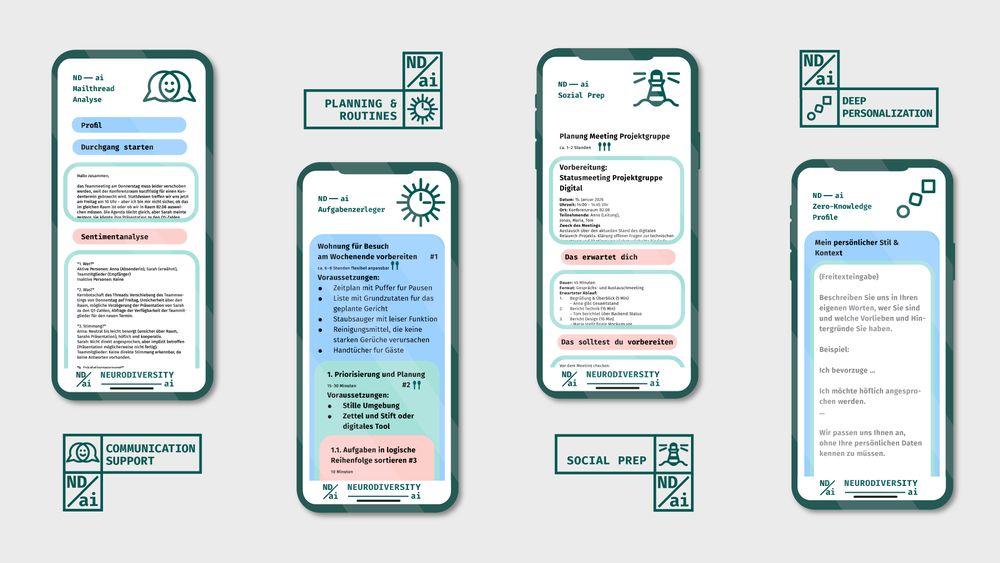
Approximately 15–20% of the world's population is neurodivergent. Yet there are hardly any digital tools on the market designed for this target group's needs.
Neurodiversity AI (ND‑ai) fills this gap in the market. ND‑ai is a ‘digital wheelchair ramp’ for cognitive and social participation, developed by Timm Bölke and Bianca Holtschke, and winner of the CAMPUSSIDEEN ‘Impact Award’.
What is ND-ai?
Neurodiversity AI is a personalised AI assistant for autistic people and people with ADHD. It acts as a translator by making subtext visible, helps users prepare for appointments, and structures to‑dos into manageable steps. The assistant can also prepare users for social situations such as meetings or private appointments. This reduces cognitive load and stress, and creates new scope for authentic participation in work, study and everyday life.
In the interface, the team focuses on low‑stimulus design and clear hierarchies. The concept deliberately avoids pop‑ups and gamification. Users can adapt all tools to their individual needs.

Catalogue, 232 × 328 mm, 171 pages
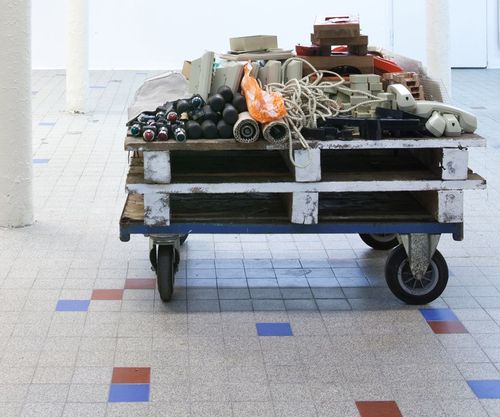
The source material consists of objects left behind after a ship electronics company relocated from its premises in Walle, a district of Bremen. Ragna Müller and Bianca Holtschke built an archive from these finds, comprising series, individual objects and working materials. The publication presents the objects in the quantities in which they were found and at correctly matched relative scales, enabling direct comparison. The cover design references the specific locations within the building where the objects were found.
Supervision: Prof. Alexander Sahoo, Prof. Dr Andrea Sick, Uschi Huber.